Betye Saar, Former Otis College Faculty Member and Renowned Artist, Has Died.
Saar passed away four days shy of her 100th birthday.
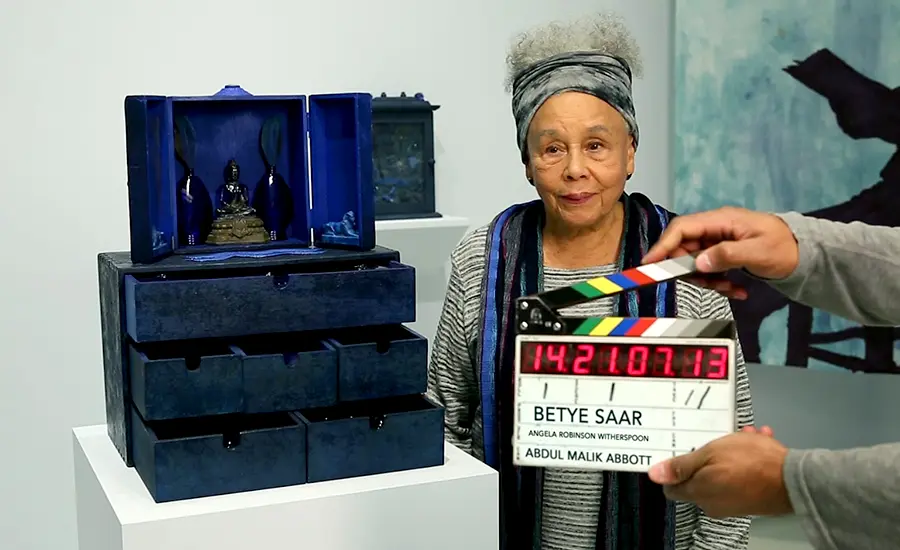
Film still from Angela Robinson Witherspoon’s documentary Betye Saar: Ready to be a Warrior
Betye Saar, renowned assemblage artist and printmaker, former Otis College faculty member, and parent to alum Alison Saar (’81 MFA Fine Arts), has died. She was 99 years old. In 1992, Saar was awarded an honorary doctorate from the College.
“Betye Saar’s broad impact as an artist and teacher cannot be overstated. Otis will continue to teach and celebrate her work. To countless former students and colleagues, she represents the absolute best of Los Angeles and what is possible here,” says Otis College President Charles Hirschhorn.
Over a career spanning more than six decades, Saar impacted contemporary art through her assemblage work, using found objects, family heirlooms, and everyday artifacts to explore history, memory, spirituality, and Black identity. A leading figure of the Black Arts Movement, she challenged racist stereotypes by reclaiming and recontextualizing images from American popular culture, most famously in her landmark 1972 work, The Liberation of Aunt Jemima. Through her work Saar demonstrated how art could confront injustice, preserve cultural memory, and tell deeply personal stories.
Alongside her artistic practice, Saar was a dedicated educator and mentor who encouraged generations of emerging artists to draw from their own histories, cultural traditions, and lived experiences as sources of creative expression.
“Through the metamorphosis, elevation, and continuous reinvention of everyday objects, Saar's work centered history, memory, dreams, and experiences. She and her transformational work will continue to inspire future generations of students at Otis and beyond,” says Otis College Provost Colette Veasey-Cullors.
In the Los Angeles Times’s obituary of Saar, Carolina A. Miranda writes, “As Saar’s 100th birthday approached, her work and its groundbreaking importance were celebrated afresh in a slew of articles, including this recent profile in The Times. As she approached the momentous milestone, Saar appeared more interested in creating new art than in dissecting her legacy. ‘That’s what art is,’ she told The Times in an interview in late June. ‘Making something where there was nothing.’”
A Prolific Artist and Lasting Legacy
Saar has been featured in hundreds of exhibitions throughout the United States and internationally, earning widespread recognition as one of the most influential artists of her generation. Early solo exhibitions at the Whitney Museum of American Art and the Studio Museum in Harlem established her as a leading voice in contemporary art.
In 2019, the Los Angeles County Museum of Art (LACMA) and Museum of Modern Art (MOMA) in New York held concurrent exhibitions—Betye Saar: Call and Response and Betye Saar: The Legends of Black Girl's Window, respectively—which celebrated Saar’s enduring influence and introduced her to new audiences.
From The New York Times’s obituary of Saar: “the artist credited her interest in assemblage to two influences. One was the slowly growing Watts Towers, which she liked to visit as a girl with her grandmother. The Italian immigrant Simon Rodia spent decades building these soaring structures by hand, embedding in concrete an array of broken glass, tile, ceramics and more.
‘I was fascinated by how he used bottle caps and corn cobs and broken plates—trash, essentially—to make art, to make something beautiful,’ she told The New York Times in 2024. In the Getty oral history, she compared the towers to ‘strange castles’ from the fairy tales that she loved as a girl.
The other eye-opener, she said, was a major exhibition at the Pasadena Art Museum in 1967 of the work of Joseph Cornell, with its array of surrealist-tinged, memento-laden boxes, featuring poetic assortments of marbles, letters, feathers and more. She remembered each box being as dramatically spot-lit as a precious gem.
The Cornell show inspired her to set out to create what she often called her own ‘magical little worlds.’”
Saar’s work is held in the permanent collections of many of the world's leading museums, including MOMA, the Whitney Museum of American Art, LACMA, the Smithsonian American Art Museum, the National Gallery of Art, the Art Institute of Chicago, the Metropolitan Museum of Art, and the San Francisco Museum of Modern Art. In 2018, the Getty Research Institute acquired Saar’s archive as part of its African American Art History Initiative, preserving documents, photographs, sketchbooks, correspondence, and other materials that chronicle her remarkable artistic career for future generations.
Saar’s work is on view at Roberts Projects in Los Angeles with Let's Get It On: The Wearable Art of Betye Saar, featuring her costume design work, through August 22. Betye Saar's Black Dolls is on view at The New York Historical through October 4, and The Huntington in San Marino, California is showing Betye Saar: Drifting Toward Twilight through November 30, 2027.
Read More: 5 powerful works by Betye Saar that represent her fearless vision, in art and life