Navy Veteran and Otis College Alum Justin Wilson Brings the Art of Tattooing into the Classroom
Wilson draws on his professional and military experience to teach Otis College’s first Illustration for Tattooing course, in collaboration with legendary artist Mister Cartoon.
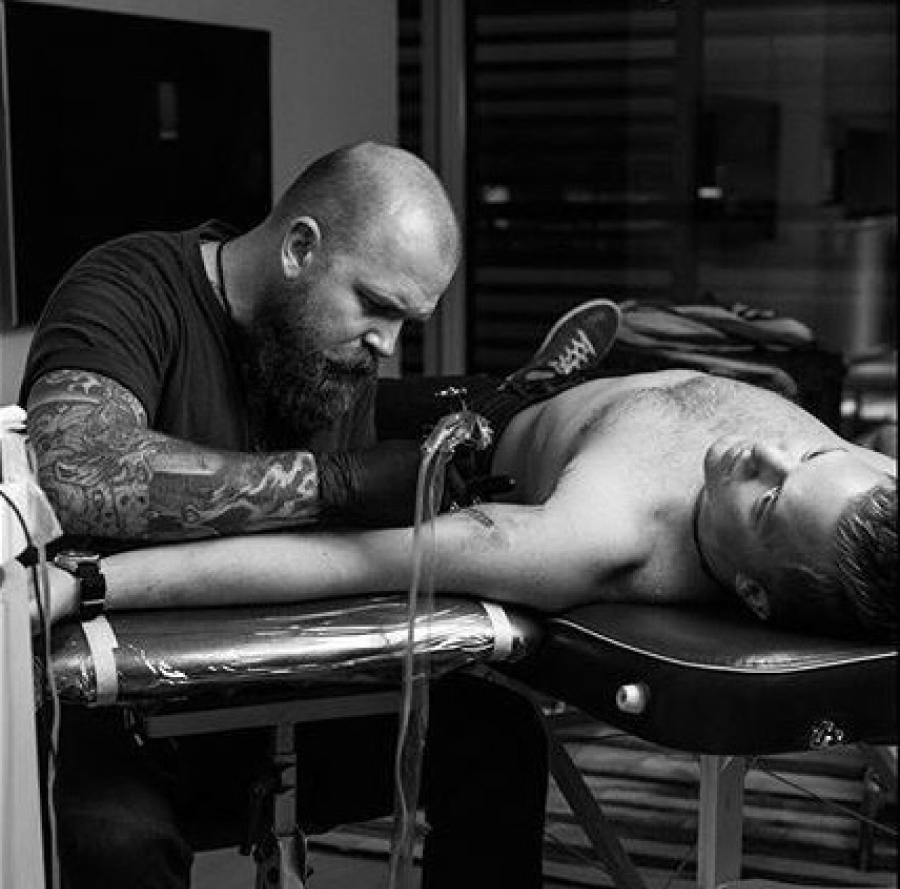
Justin Wilson didn’t follow a traditional path toward his career as an artist. He enlisted in the United States Navy when he was only 17, serving 12 years. Tattooing became a creative outlet for him while he was on active duty; he even took his tattoo equipment on every deployment and training trip. “When I got out of the Navy, I only knew two things for sure: I was moving home to California, and I was going to tattoo,” he says.
He admits his career path has been unconventional—“one thing just seemed to lead to another”—but the throughline was his love for drawing, painting, and tattooing. Through Otis College’s Yellow Ribbon Program, he completed his BFA in Fine Arts in 2015 and his MFA in Fine Arts two years later. The program helps bridge the gap between VA education benefits and private school tuition, making an Otis education more accessible to veterans.
Fast forward 10 years and Wilson now owns Windansea Tattoo, a private tattoo studio in La Jolla, California. “I’ve tattooed internationally, received awards for my work both domestically and abroad, and developed a practice that combines traditional tattoo craftsmanship with contemporary illustration and fine art,” he says.
Wilson also began teaching part-time in the Illustration program at Otis College, where, he says, “It’s nice to see the veteran community still alive and well, with continued support from faculty leadership.” This past year Wilson received what he calls “one of the raddest emails ever,” when Illustration Chair Brendan Griffiths reached out to him about teaching Otis’s first-ever class dedicated to tattooing. Illustration for Tattooing combines everything that Wilson loves about his craft—drawing and design—with the practical experience he’s gained as a self-employed tattoo artist and military veteran.
A Collab with Mister Cartoon
The idea for Illustration for Tattooing originated with College leadership, who brought it to Griffiths and Dean of Academic Affairs Dwayne Moser. There was a desire for the course to explore tattooing and the industry, but to also stand out in a way that only an Otis College course can, which is why world-renowned tattoo artist Mister Cartoon was brought on as a collaborator. The class combines Wilson’s instruction and lectures with studio visits and a collaborative final project with Mister Cartoon.
“This semester offers a once in a lifetime experience,” Wilson says. “We have the rare privilege of partnering with Mister Cartoon and his studio, connecting academic instruction with the realities of contemporary tattoo practice.”
Wilson’s goal is to explore tattooing as a legitimate and sophisticated discipline
within art and design. The course introduces students to tattoo history, visual traditions,
design methodology, and the practical considerations that distinguish tattoo illustration
from other forms of image making. There is a lot of drawing and painting, but also
a look at how tattoo designs have evolved, and why certain techniques and styles have
stood the test of time.
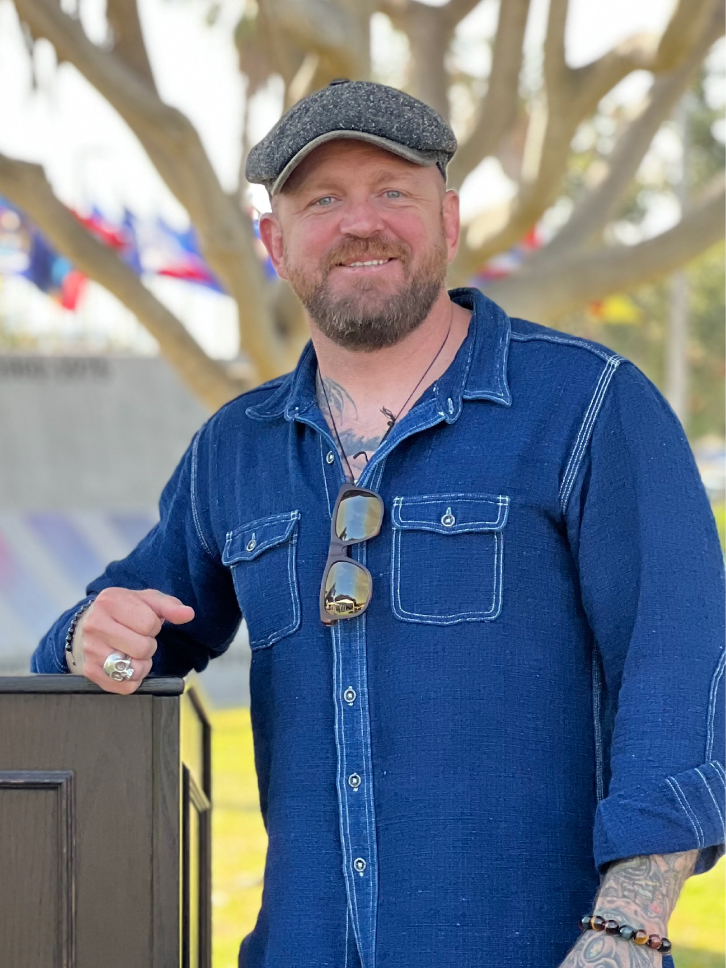 Another unique feature is the course’s emphasis on the practical aspects of the industry,
including working with clients, developing designs, and understanding what it takes
to make a living as a tattoo artist. In addition to visiting Mister Cartoon’s studio,
students also went to United Ink in North Hollywood and the Golden State Tattoo Convention
in Pasadena. “These are opportunities to see the industry firsthand, meet people working
in it, and get a better understanding of what a career in tattooing actually looks
like,” Wilson says. “If a student decides to pursue an apprenticeship, they’ll have
a much clearer picture of what they’re getting into.”
But the class is also suited for any student interested in illustration, design, and learning something outside of their usual discipline. “Tattooing requires a strong understanding of composition, line quality, contrast, and visual communication. Those are skills that apply to just about every area of art and design,” Wilson says, adding that designing for the human body involves a three-dimensional surface that moves, changes, and ages. “Something that looks great on paper might not translate well to skin. I think that presents a unique challenge for students, regardless of what they eventually want to do professionally.”
This class recognizes tattooing as a legitimate creative discipline while giving students another avenue to explore professionally.”
Tattooing’s acceptance in the traditional art world has changed considerably over the last few decades. The discipline influences fashion, advertising, illustration, fine art, and popular culture. Wilson lauds Otis College for adding Illustration for Tattooing to its curriculum. “Just because something wasn’t traditionally taught in an art school doesn’t mean it doesn’t belong there,” he says. “I think institutions like Otis have a responsibility to recognize those changes and adapt—they shouldn’t just teach students how things have always been done. They should also be looking at where the industry is going. I think offering a class like this is a good example of that.”
Bringing Experience into the Classroom
The emphasis on career readiness is a hallmark of an Otis College education and where Wilson’s experiences, both in the military and as a creative business owner, are exceptionally helpful. “In the military you learn pretty quickly that things rarely go according to plan,” he says. “You have to assess the situation, make decisions, and adapt to whatever is happening around you.” He compares that adaptability to art and design, and encourages his students to lean into an iterative process: “You can have a great idea in your head, but once you start putting it on paper, you might realize it isn’t working. You have to be willing to change direction, sometimes completely.”
Group critiques are an important part of his class, but Wilson also encourages students to learn how to critique their own work. “One of the things I try to get across is that your first idea isn’t always your best idea,” he says. “Sometimes you have to go through several versions of something before you arrive at a design that really works.”
What’s more, being a professional artist or designer rarely happens in a vacuum. “There are a lot of incredibly talented people who struggle professionally because they don’t understand the business side of what they do,” Wilson says. “Students need to understand that being a professional creative requires more than just making good work. Learning how to communicate, manage expectations, and put a value on what you do is part of building a sustainable career.”
It’s pretty rewarding when you see a student make a connection or discover something they didn’t know they were capable of.”
Just as much as Wilson is there to offer students his experience and expertise, he acknowledges that he’s still learning and that his classroom is as much for him as for them. “After 23 years of tattooing, I’ve developed methods that work for me, and sometimes I don’t even think about why I do them anymore. Students have a way of challenging that,” he says. “They’ll ask a question or approach an assignment in a way I hadn’t considered, and suddenly I’m looking at something I’ve done for years from a completely different perspective.”
It’s a full-circle moment for him. “I remember being on the other side of the classroom, having professors challenge the way I thought about my work,” he says. “Sometimes I didn’t understand what they were trying to get across until much later. Now I get to experience that from the other side. It’s pretty rewarding when you see a student make a connection or discover something they didn’t know they were capable of. Teaching forces me to explain things that have become second nature. Sometimes, in the process of explaining something to a student, I end up learning something about my own work. I think that’s important. No matter how long you’ve been doing something, there’s always more to learn.”
Explore Otis College’s Illustration program.
View Justin Wilson’s Windansea Tattoo Studio.
Related News