Chris Eckardt’s Ongoing 26-Year Commitment to Otis College Students
For over two decades, Eckardt has brought an evolving professional practice to Otis Animation and Game Design students.
When Chris Eckardt encourages students to pay attention to what the artist next to them is doing, the advice comes from decades of professional experience across creative disciplines.
Eckardt, a professor who teaches in Otis’s BFA Animation program and has taught for the BFA Game and Entertainment Design program, works as a visual effects and CG supervisor, cinematographer, creative director, and director across film, television, and commercial projects. He began teaching at Otis College in 2000 and more than 25 years later, he remains passionate about working with students.
For Eckardt, the classroom and industry share a symbiotic relationship. “In my experience, teaching—especially with passion, empathy, and real responsibility—is extremely demanding. At the same time, it is also one of the most rewarding things in my life. I feel fortunate to be able to do both,” Eckardt says.
His path to teaching and industry work began with an unexpected change in direction.
As a college student attending Washington State University, Eckardt initially studied microbiology and immunology. When he found himself struggling, a professor offered to test his aptitude and help identify another path. The results pointed toward something more visual and tactile. Eckardt shifted to photography and sculpture and eventually joined an early wave of students studying computer graphics, which were then housed within computer science departments.
That experience established principles that have continued to guide him throughout his career: remain curious, learn new tools, and be willing to move between disciplines.
Training and Teaching
While taking graduate-level courses in computer graphics, Eckardt landed a job with Wavefront Technologies that brought him to Santa Barbara, California, where he trained clients to use the company’s emerging graphics software. By the 1990s, his combination of visual sensibility and technical dexterity led to opportunities in video game development and publishing with Accolade Video Games in Cupertino, as well as work with motion capture technology.
Teaching entered the picture later that decade. An initial meeting with a company in Japan eventually led Eckardt to help open DH Institute of Media Arts (DHIMA), a Santa Monica school that offered instruction in prominent industry software supporting 3D modeling, animation, and visual effects training for undergraduate and certificate programs. He initially served as head of academics before becoming the school’s president.
From that point forward, Eckardt made a deliberate choice to keep education and professional production running in parallel. While his schedule has looked daunting at times, he says teaching has consistently provided the energy he needs to return to professional settings.
His work has included time at companies such as Psyop, Pixel Envy/Light Matters, Stardust, Prologue, and Imaginary Forces. He co-founded commercial and music video studio Moneyshots Post, whose work on OutKast’s “Hey Ya!” music video received a VMA for Best Visual Effects. In 2013, Eckardt became a founding member of visual effects house Framestore’s Los Angeles office, where he led major creative campaigns for clients including Apple, Nike, Facebook, and Pepsi.
Connecting the Classroom to Industry
For Otis students, this broad experience means lessons on creative practice are connected to the realities of industry work. Recent courses Eckardt has taught at Otis include 3D Fundamentals, Lighting: CG & IRL, Animation Explorations, and Advanced Senior Projects.
Eckardt encourages students to remain curious about disciplines beyond their area of study and understand how their work connects to a larger creative process. Once students find their footing inside a company, he challenges them to think beyond simply completing assigned tasks and to consider how they can become an asset to the organization.
That mindset becomes particularly important as the tools used by creative professionals continue to evolve.
Eckardt has seen computer graphics advance from a specialized emerging technology into an integral piece of contemporary entertainment and design. Today, artificial intelligence presents yet another shift. Through his teaching and professional work across the globe, especially in Asia, he has observed environments where AI use is already an expectation within certain creative roles.
His advice to students is to not let the technology define their work, but to consider how it might support their vision. “For me, it is important that students find their creative voice and not let anything stand in their way. A lot of it comes down to confidence and problem solving,” says Eckardt. “If I can help them build that confidence, even in a small way, and encourage them to go after their ideas and dreams, then I am at peace.”
The tools will change, Eckardt notes, but a strong sense of design and knowing what looks good remains fundamental. His own career offers evidence of that adaptability. Even as he has moved among emerging technologies and between different areas of digital production, his practice has remained grounded in visual thinking. Beyond his digital work, Eckardt crafts bronze and wood figurative sculptures and is a published architectural and commercial photographer.
At Otis, Eckardt brings a combination of artistic foundation, technological curiosity, and professional experience directly to students. His commitment to education was highlighted in 2020 when Otis named him a Distinguished Educator, an annual honor recognizing an outstanding faculty member.
More than two decades after he first entered an Otis classroom, balancing teaching and production does not fully describe what Eckardt has built. The two sides of his career both support and reinforce each other.
His professional practice allows him to bring students firsthand knowledge of how creative industries operate and evolve while teaching keeps him engaged with new ideas and the curiosity of emerging artists and designers.
To students, Eckardt recommends staying curious about the people and practices around them, developing a strong visual point of view, and making their creative abilities valuable regardless of where their career takes them.
More on Chris Eckardt on Otis.edu
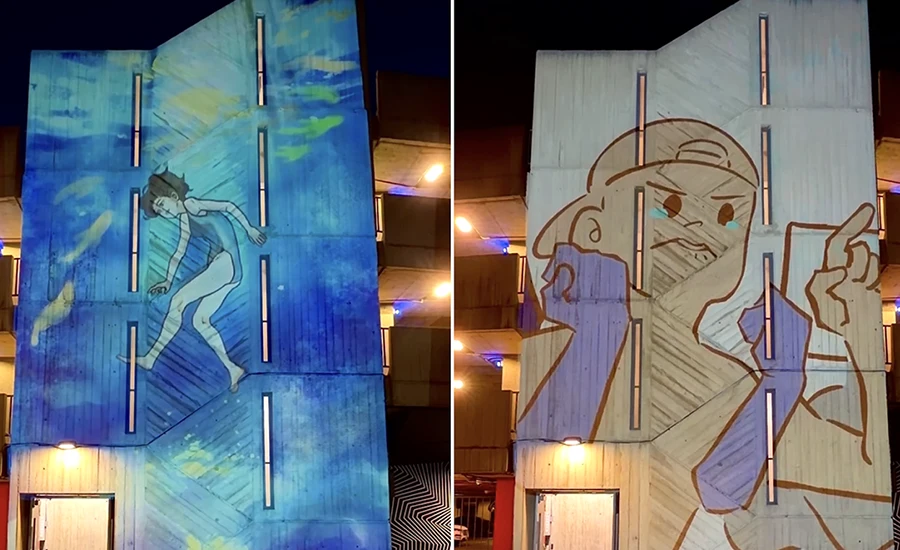
*Top image details: students created projects to fit a vertical canvas over 30 feet tall, projected onto the unique graphic facade of the Otis College parking structure. This gave students the chance to develop portfolio projects while also showing work in a public venue on a truly unique canvas.
Related News


From Otis Design Lab to Full-Time Designer
July 22, 2026