More Than a Place to Sleep: How Student Housing Fosters Success at Otis College
Being a residential student comes with perks like free laundry, but also access to community and support.
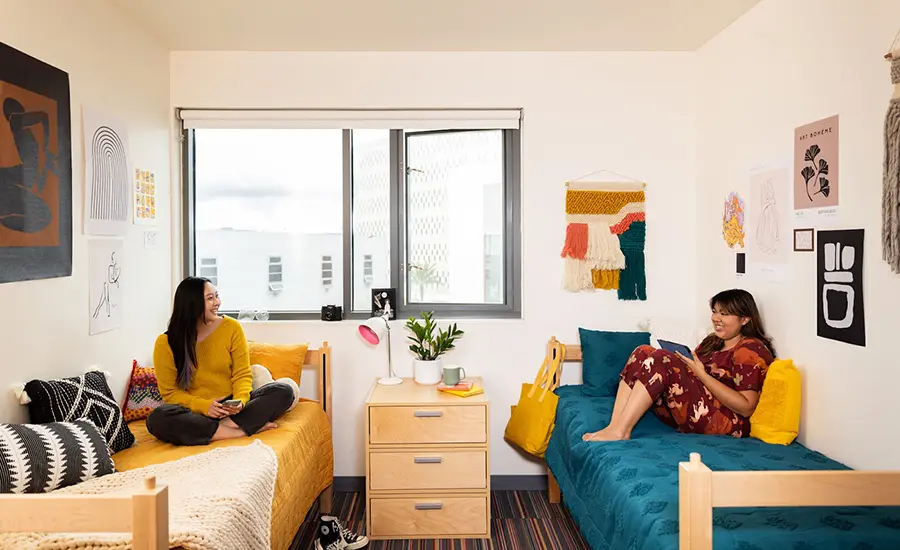
Otis College students inside a shared dorm room in the Residence Hall. Photograph by Gina Cholick/Otis College of Art and Design.
For many students, arriving at college is their first real taste of independence. It requires them to manage their own schedules, navigate new relationships, and build an adult identity away from home. At Otis College of Art and Design, student housing is designed to support that transition in ways that go far beyond providing a roof and bed.
Otis offers two housing options. The Residence Hall primarily serves first-year students, immersing them in a built-in community of fellow artists and designers from day one. Across the street, Park West Apartments offers apartment-style living for continuing students, complete with amenities such as swimming pools, a fitness center, and free parking. Together, the two communities house roughly 400 students, all supported by a network of resident assistants (RAs) and live-in professional staff.
At Otis, creative work rarely ends when class does. Students often spend evenings in labs and studios, bringing projects to life. Living nearby means spending more time creating and less time commuting."
For Melinda Ambani, Director of Residence Life and Housing at Otis College, the value of living on campus starts with one word: growth. College housing is the first place students learn how to live with people whose habits, background, and values may differ from their own. “Who forgot to do the dishes? Who stayed up too late?” These situations may seem minor, but Ambani sees them as essential opportunities to develop conflict resolution skills: “There really is no better place for a student to learn,” she says, “but it requires leaving the comfort of their home.”
A Foundation for Academic Success
The benefits of campus living become especially apparent during the first year, when students are adjusting not just personally, but academically. Residence Hall students literally live on top of the resources they need most, including the dining hall, library, and the Student Learning Center. They also are minutes away from classrooms, faculty meeting spaces, the Student Health and Wellness Center, and the Labs, Shops, and Studios. For art and design students, that proximity matters.
At Otis, creative work rarely ends when class does. Students often spend evenings in studios, the wood shop, or the photography lab bringing projects to life. Living nearby means spending more time creating and less time commuting.
“You need those hours,” Ambani says, adding that residential students tend to be more academically successful and are less likely to withdraw or drop out. “Housing provides that space and a firm, safe foundation.”
A Smart Value
Cost is inevitably part of the housing conversation, especially in a large city like Los Angeles, where the average monthly rent price is $2,184. Alezaé Cary, Assistant Director of Residential Communities at Otis College, encourages families to consider everything included in the residential experience, where the average monthly housing cost is $2,116 for a shared room in the Residence Hall, which includes a 10 Meal Plan. “Housing also provides essential furnishings, internet access, free laundry facilities, and a meal plan—expenses that students living off campus would often need to budget for separately,” she adds.
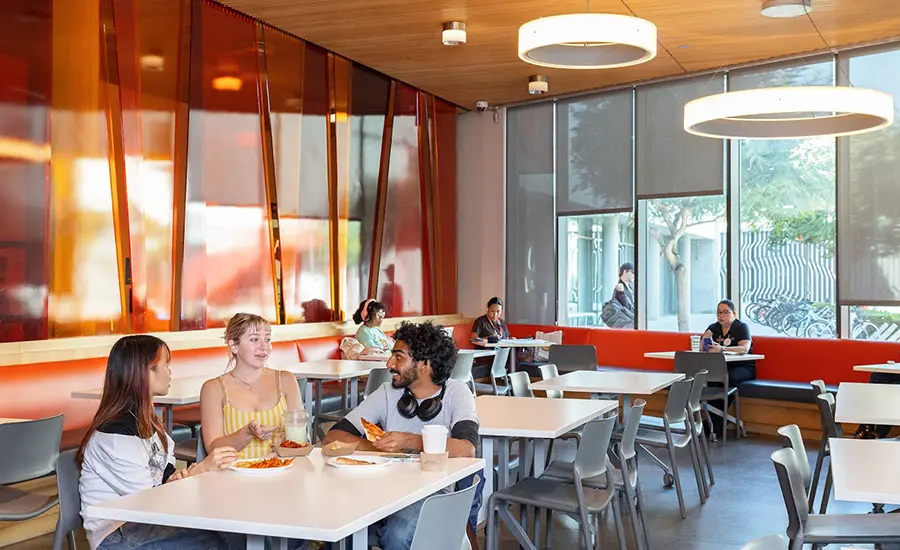
Otis College students inside Elaine’s Dining Hall. Photograph by Sarah Golonka/Otis College of Art and Design.
Residential students dine at two options through Bon Appétit. At Elaine's Dining Commons, meals are prepared from scratch with seasonal ingredients sourced through Bon Appétit’s Farm to Fork program from farms and ranches within 150 miles of campus. There’s also the Rose Hills Foundation Cafe for coffee and quick snacks and baked goods.
Practical perks also add up. Free laundry eliminates one common student headache (and the eternal hunt for quarters), while the meal plan alleviates the hassle of grocery shopping and cooking. Most importantly, Cary emphasizes, on-campus living delivers something no lease can: a built-in support network during a pivotal period of growth.
“The value of living on campus isn’t just the room itself; it’s the access, support, and sense of community that come with it,” she says. “Students have daily opportunities to build friendships, develop a sense of belonging, and engage with the Otis community in meaningful ways. When families consider both the tangible benefits and the student experience, many find that living on campus offers value that extends well beyond housing alone.”
Then there’s Otis’s prime location, just a short bike ride from the coast with Playa del Rey and Dockweiler Beach roughly 10 minutes away—an easy escape when a student needs to trade the studio for the surf.
RAs as Community Builders
A strong residential experience depends on well-trained student leaders. Cary works closely with Otis RAs to prepare them for everything from routine roommate concerns to more serious student challenges. Rather than allowing problems to escalate, Residence Life and Housing staff take a proactive approach. During orientation, residential students participate in community circles designed to help them move beyond surface-level introductions and establish a foundation of trust and respect. “We always tell them: don’t wait, communicate,” Ambani says. “They may still experience conflict, but we provide a nice, safe space to help them manage it.”
RA training includes sessions led by campus partners such as the Student Learning Center, Career Services, Student Affairs, and Counseling and Psychological Services. By building relationships with these professionals early, RAs are better equipped to connect students with the resources they need. “Our goal is not for RAs to have every answer; it’s for them to know how to connect students with the right support at the right time,” Cary says. “By equipping RAs with both practical skills and a strong network of campus resources, they are better prepared to help students navigate challenges, build a sense of belonging, and thrive during their college experience.”
That level of support is one of the clearest distinctions between campus housing and simply renting an apartment. While a landlord’s responsibility largely ends with the lease, Residence Life and Housing staff at Otis are invested in students’ overall development. Their families also have the reassurance of 24/7 Campus Safety coverage.
Social Hours
If the academic case for campus housing is compelling, the social one is downright fun. On any given night, residential students might make felt photo holders at Craft Night, search for clues during a circus-themed scavenger hunt, or compete in a Sanrio Foosball Tournament. Past events have included an aromatherapy workshop and a RuPaul’s Drag Race finale watch party. Free and typically held in the evenings, these programs give students a chance to step away from the studio, decompress, and find their people. Participation tends to run high, in part because the events are happening right down the hall.

Otis College students on the Commons lawn, located in front of the Residence Hall.
Photograph by Sarah Golonka/Otis College of Art and Design.
Students looking for a deeper level of engagement can join I.M.P.A.C.T. (Inclusion, Mindfulness, Professional Development, Academic Excellence, Creative Service, and Transformation), a leadership-focused community of 10 to 20 residential students. Participants have learned bike safety with Biking While Black, created flower bouquets with the Counseling Center, and taken part in other community-building events.
A First Home Away From Home
For international students, campus housing often serves as more than a residence. It becomes a first home in a new country. To ease that transition, international students are invited to move in a day early and participate in a specialized orientation before the larger move-in rush begins. The additional time helps them learn the rhythms of campus life, locate resources, and settle into their new environment.
Because international students often face challenges related to visas, travel, and securing housing from thousands of miles away, they also receive priority consideration during the housing process. Once on campus, they’re within minutes of classes and support services. For many, the residential community becomes their first network in the United States and an anchor for academic, social, and personal success.
Taken together, these details point to something larger than logistics when it comes to living on campus. They create an environment where students are supported academically, socially, and emotionally while navigating one of the most significant transitions of their lives.

Twice a year, Otis Students have an artist marketplace out on the Commons, where they sell their work. Photograph by Brianna Moreno-Angel/Otis College of Art and Design.
“There’s a lot of identity development during students’ first year as they start to figure out who they are,” Ambani says. It’s why she encourages all students, including locals, to consider living on campus for at least their first year. The benefits extend beyond convenience, helping students develop habits and skills they will carry long after college.
More Information about Residential Options at Otis College
Related News


Fine Arts Chair Meg Cranston on the Legacy of Betye Saar
October 13, 2026

Where Otis College Students Find Inspiration in Los Angeles
October 09, 2026