Robert Creighton Teaches Otis College Students to Design Within, and Beyond, Limits
The Product Design instructor helps students navigate real-world constraints, discover their strengths, and prepare for meaningful design careers.
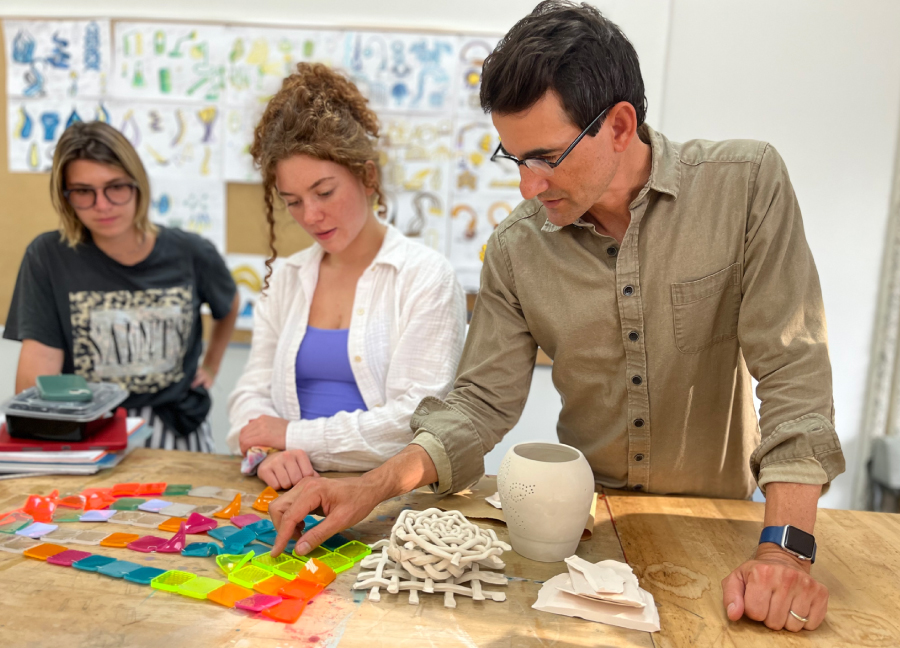
As a faculty member in Otis College’s Product Design program, Robert Creighton talks about constraints often. “I use that word a hundred times a day when I’m teaching, which is probably annoying, but ultimately design without constraints is not design,” he says.
The paradox is that the boundaries of a project ultimately allow a designer to create freely. Product design covers so much ground—physical objects like sneakers or a coffee table; digital offerings like an app or website; experiential environments like a museum exhibition—and the work has to simultaneously consider both the client and the end user.
“There are limits around materials, money, the market, and who a product is for,” Creighton continues. “These constraints are where the students can sometimes get lost. But they are the things that keep you on track with a project because they prevent you from going too far afield.”
The department’s goal is to help students figure out the path to take their ideas and make them in the world. That’s their job as a designer, to build the future.”
Just as they would with a client, Product Design students have to work within budget limitations, concerns around usability and accessibility, and consider a product’s lifespan. Sustainability has become an important criteria for students. “If you think about designing for a product’s end of life, you design it differently,” Creighton says.

By their senior year, students understand how to work within these parameters while still pushing creative boundaries. Says Creighton, “By that point they’re really starting to discover, ‘What type of designer do I want to be? What is it that I’m really interested in? Am I interested in the storytelling part of design or the making part of it?’ There are students who are just fantastic at 3D modeling, and some who are magical when they’re coding or working with AI.”
Creighton encourages his students to lean into their strengths and their unique points of view; qualities that will set them apart from others in the job market when they graduate. “Our students consistently have an entrepreneurial thread in them,” he says. “The department’s goal is to help them figure out the path to take their ideas and make them in the world. That’s their job as a designer, to build the future.”
Carving His Own Path
Playing to his own strengths and values was something Creighton learned as a product design student himself. He went to the Rhode Island School of Design (RISD) with the goal of learning how to design cars, a byproduct of his father’s interest in racecars. Growing up in Arizona, his early exposure to firearms while target shooting, as well as other tools, introduced him to the mechanical design of things. “I got the emotional side of design from cars, and the material and constraint side from tools,” he says.
At RISD, Creighton fully immersed himself in the physical act of making products while working summers for a blacksmith and a furniture maker. “I’m from the last generation of students who learned how to do hand-drafting before the transition to CAD [computer-assisted drafting] and 3D modeling,” he says.
But as he was finishing his studies, Creighton had what he calls a “crisis of confidence.” He was at a store, looking at a display of merchandise, when he realized that so much of what was being sold to consumers was “just stuff.” “It was a wall of junk, basically. And I thought, ‘I can’t design junk,’” he says.
Creighton had taken a class about designing immersive experiences—educational environments where users are encouraged to interact with the design. “That actually was really interesting to me,” he says.
He has now spent over two decades at the helm of Red Cape Studio, specializing in visitor experiences for museums, aquariums, science centers, and corporate clients. Two projects perfectly encapsulate the range of his career.
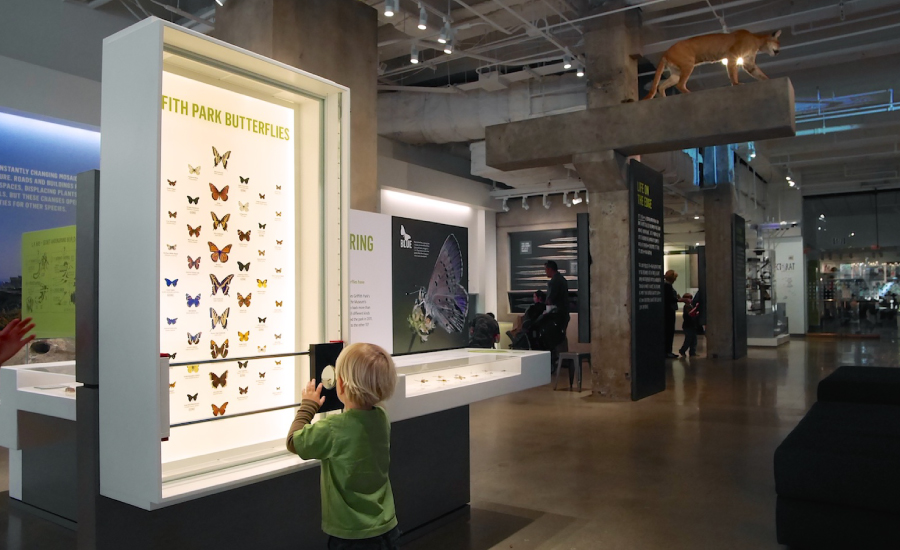
The Nature Lab in Los Angeles’s Natural History Museum was launched in 2013 as a place for visitors of all ages to learn how scientists investigate plants and animals. Red Cape Studio was hired to develop content for the lab and to design concepts for interactive elements within the exhibition.
As a designer, you’re a filter between the visitor and the institution. You’re the only person who exists on both sides of that coin.”
At the onset of the project, which took 24 months to complete, Creighton sat in numerous meetings with scientists. “They were astonishingly brilliant. And I’m not an expert,” he laughs, “so it allowed me to break down complex ideas into engaging visitor experiences. As a designer, you’re a filter between the visitor and the institution. You’re the only person who exists on both sides of that coin. Very few professions are like this.”
The Nature Lab’s exhibits were hailed by The New York Times writer Edward Rothstein as “among the most successful I have seen for children in a science museum,” and the project won numerous design awards.
Unlike The Nature Lab project, however, the “No Justice, No Peace: LA 1992” exhibit at the California African American Museum came together in just under two months back in 2017. Red Cape Studio was hired to design the physical layout and structures for the exhibition, which was about the 1992 Los Angeles uprisings that occurred after four police officers were acquitted in the beating of Rodney King.
Creighton didn’t live in Los Angeles in 1992, so the project required him to have an open mind. “I tried to think of myself not as a professional, but as an amateur when I was in those meetings,” he says. “I had to learn from the curators who, in this case, were not just telling the story of ’92. They were telling a story of why ’92 was inevitable, and that’s not something I’d thought about.” The exhibit covered such a wide-range of topics as racism, endemic poverty, joblessness, and homelessness in a way that was intended to conjure reflection and conversation.
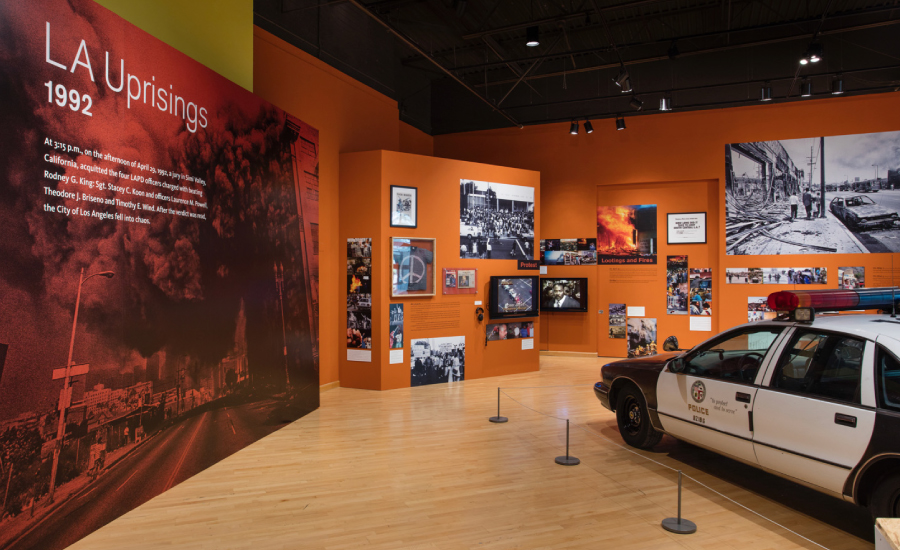
The exhibit’s physical space included recordings of the Rodney King beating, a cinder block wall used to divide sections, and such artifacts as an LAPD police car. “It was the first time I’d ever worked on something that was so topical, historical, and yet appropriate for the time,” Creighton says. “It showed me that these are the kinds of projects that I like to work on because they can really make an impact.”
Designing an exhibition space entails all facets of product design—furniture, objects, and interactive displays. “Instead of designing one object and having it produced half a million times, I can design one project and have 500,000 people come visit it,” Creighton says. “This involves a different mindset, to think about what product design is for: I’m going to bring people to the object rather than bring the object to the people.”
Mentoring Design Lab Students
Creighton hopes to help students find their own niche in the same way he found his. One way he’s done so is in his role as academic advisor to Otis Design Lab, the only design studio in L.A. that functions as a collaboration between students—working across majors and disciplines—staff, faculty, and external clients.
“One thing I love about Design Lab is that it gives students real-world experience and professional preparation, which builds on everything we do at Otis,” he says.
Since its launch in 2020, Design Lab has worked with over 30 clients on 50 projects, from a line of merchandise sold at The Huntington and a visual identity for LAist’s annual gala, to a modular furniture set for Jonathan Louis and an award-winning recycled tote bag that was sold in Otis’s on-campus art supply store, Graphaids.
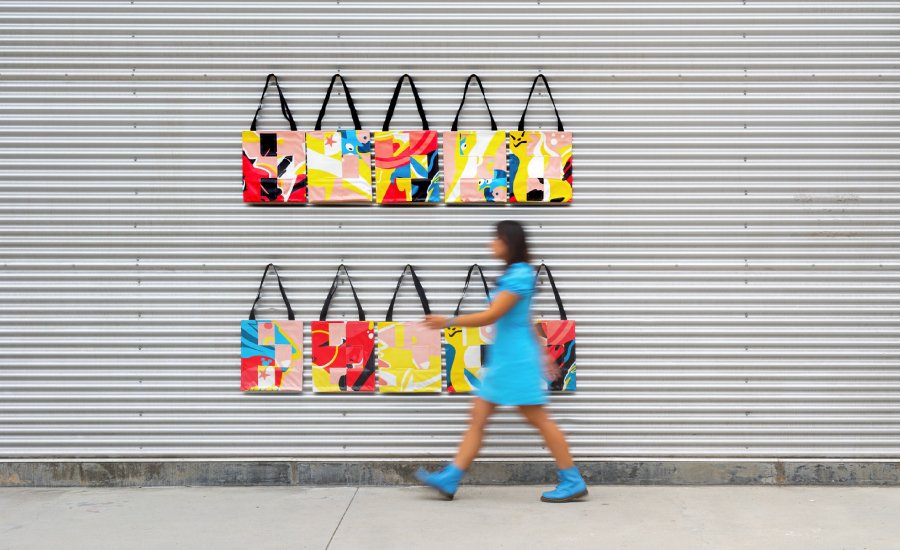
“Our role is to guide the students around staying on track, on time, and on budget with a project, skills that are critical for their future careers,” he says. “We have a clear project schedule, clear deliverables, clear timelines for those deliverables, and a clear budget. In real life, if any of those things go out of whack, you lose money immediately.”
Design Lab students are the most engaged students I have ever worked with in all the departments that they’re drawn from.”
Design Lab students have thrived on these projects. “They are the most engaged students I have ever worked with in all the departments that they’re drawn from,” Creighton says. “They’re finding that balance between being open-ended enough to explore their ideas, but then being able to pull it back and deliver to a client.”
For Creighton, it all comes back to those constraints. “If the client gives us good constraints, they get excellent designs. There are students who really embrace the constraints and thrive and flourish,” he says. “I’m hopeful because of them. I see what they’re making, I see their vision of the world, and I’m amazed by it.”
Read about the Product Design program at Otis College.
Visit Red Cape Studio’s website.
Related News
Chris Eckardt’s Ongoing 26-Year Commitment to Otis College Students
September 02, 2026