Vic Hsu
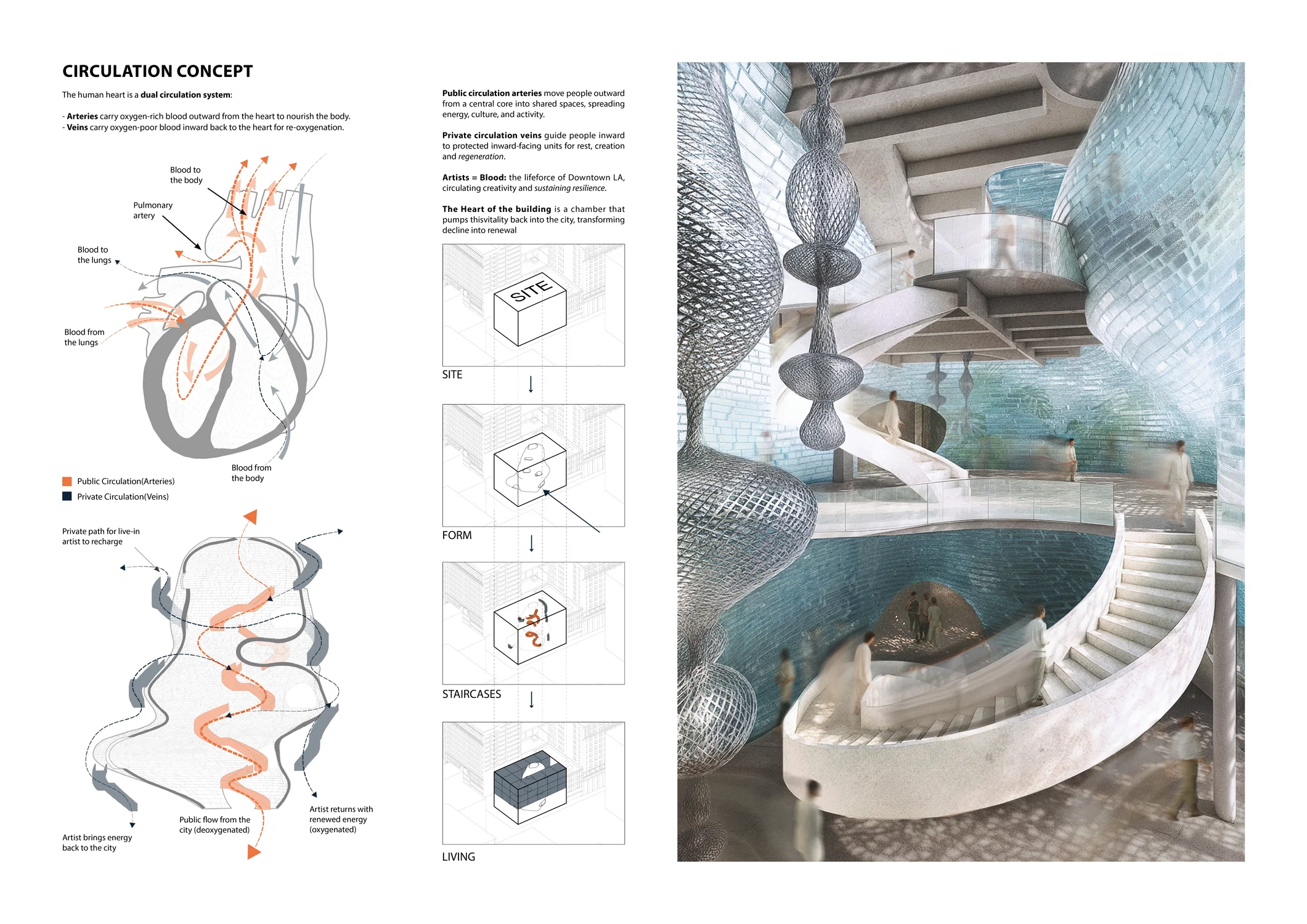
Downtown Los Angeles is continually transforming itself. From theaters, to jewelry, to manufacturing, to today’s vacancies, its cycles of change mirror the rhythm of a heart: contraction (decline) and expansion (renewal) The human heart is a dual circulation system: Arteries → carry oxygen-rich blood outward from the heart to nourish the body. Veins → carry oxygen-poor blood inward back to the heart for re-oxygenation.Some images may be cropped. Click on an image to see the full image without cropping.
Vic Hsu
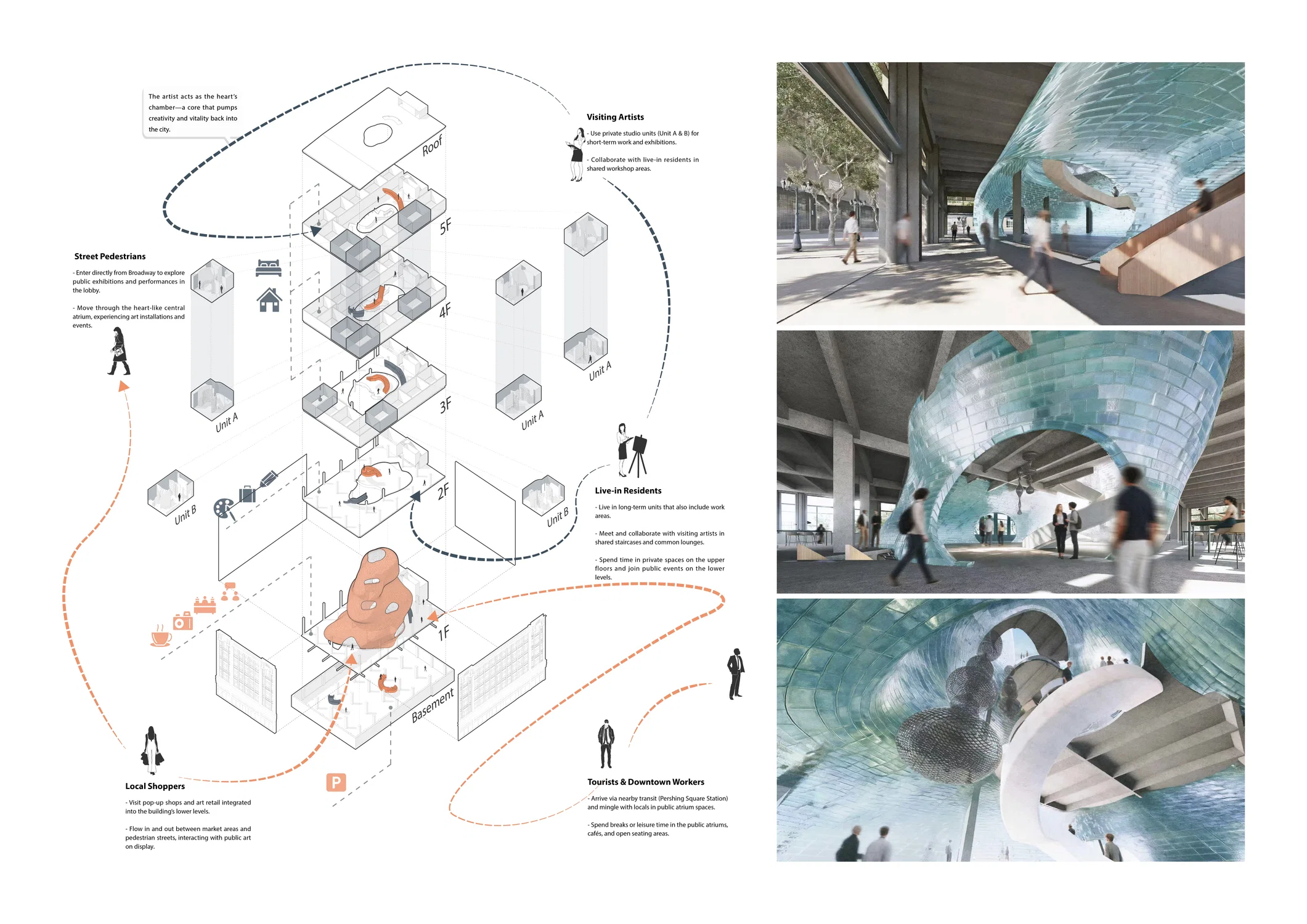
The project reimagines this system as social infrastructure, not just a building, but a living framework where: - Public circulation arteries move people outward from a central core into shared spaces, spreading energy, culture, and activity. - Private circulation veins guide people inward to protected, inward‑facing units for rest, creation and regeneration. - Artists = Blood: the lifeforce of Downtown LA, circulating creativity and sustaining resilience. - The Heart of the building is a chamber that pumps this vitality back into the city, transforming decline into renewal.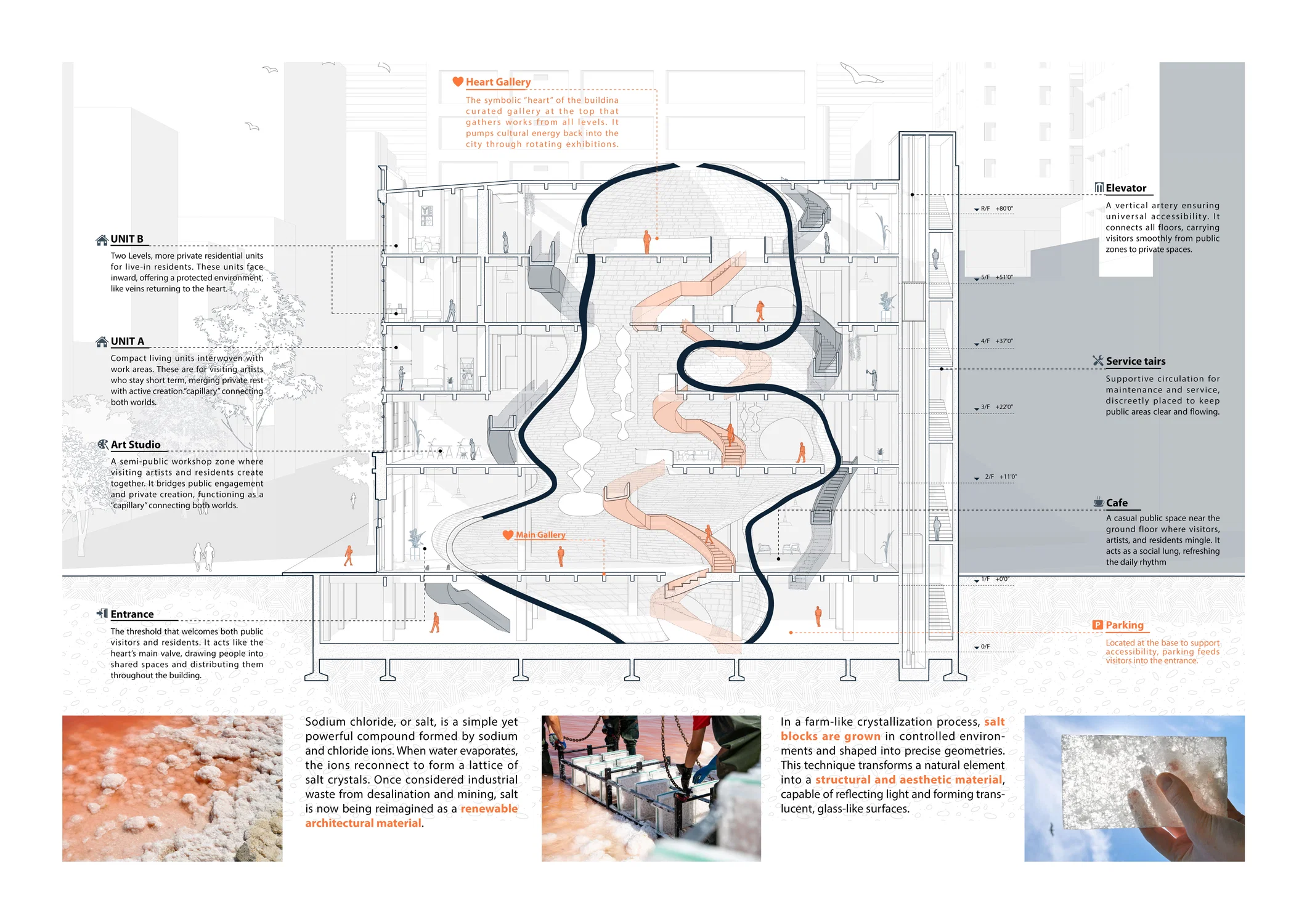
Vic Hsu
Section of the project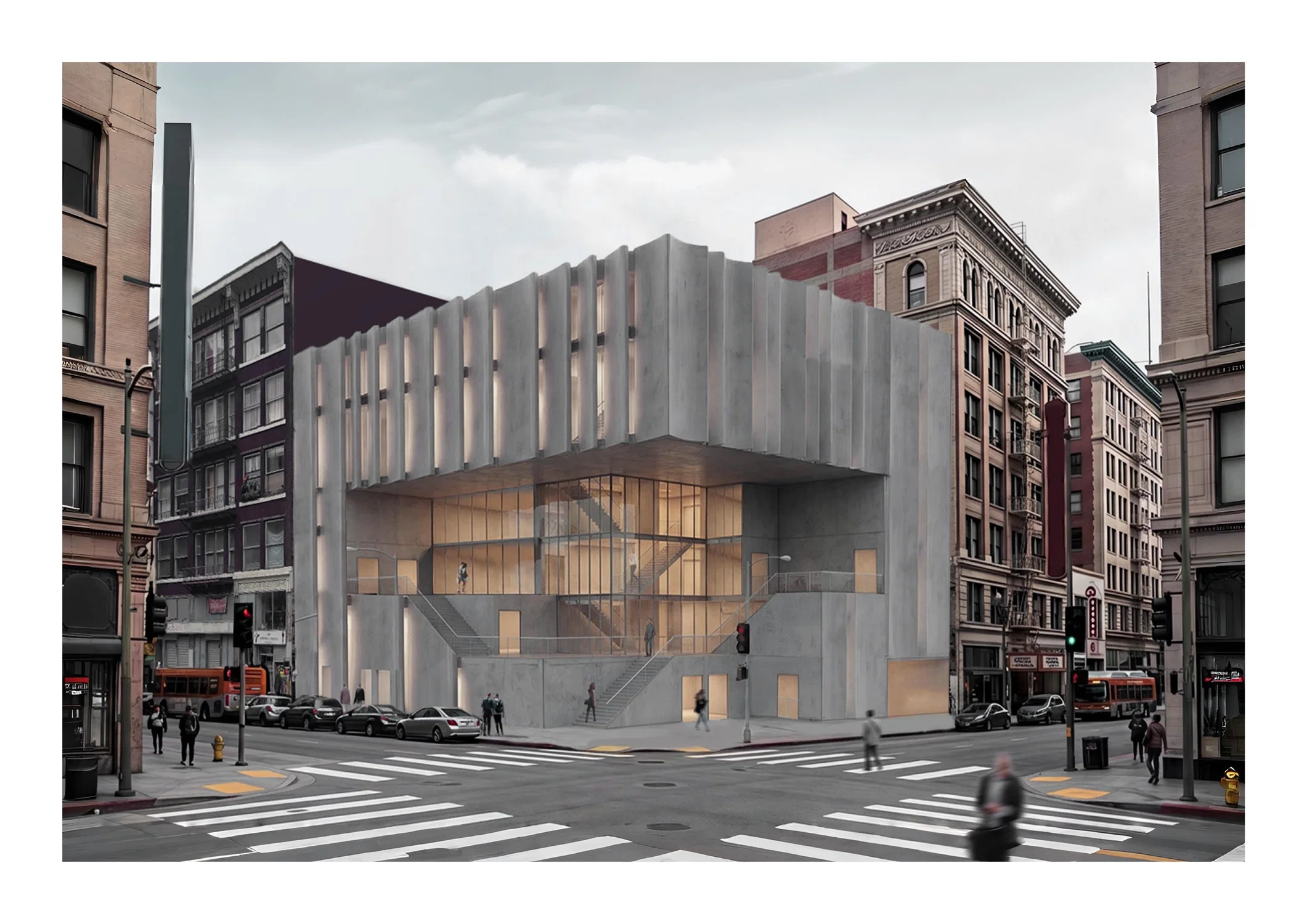
Vic Hsu
Studio 5 a perspective view of the project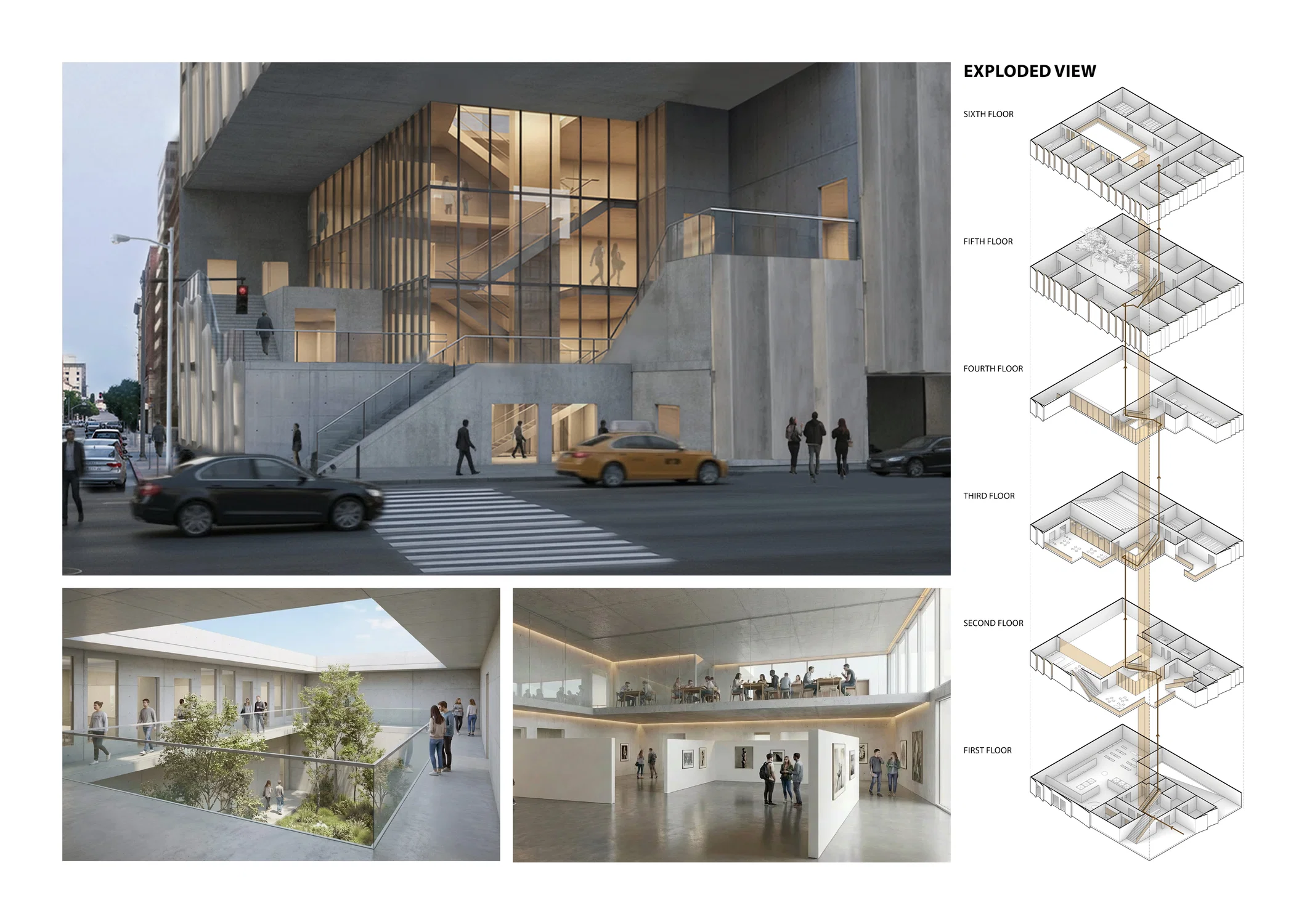
Vic Hsu
Downtown Los Angeles has long moved in cycles of intensity followed by decline. Broadway was once the busiest theater district in the United States, but as retail, offices, and public life gradually moved elsewhere, the area lost its continuous urban rhythm. Today, activity peaks during the day and rapidly fades after 3PM, leaving the street quiet and under-activated at night. This project responds directly to that broken rhythm. Beginning as a simple solid block, the building is strategically carved to pull movement inward and upward. The carved outs generate two circulation systems that operate differently across the day: During the day: an exterior public climbing path invites pedestrians from the street, activating the facade and reestablishing movement along Broadway. During the night: an interior vertical glass core becomes the primary zone of activity, glowing outward and making academic life visible to the city. Together, these circulations establish a clear day-night sequence, public energy on the exterior and academic activity on the inside. By splitting the circulation between exterior openness and an interior luminous core, the building restores the missing rhythm in this part of DTLA, activating the street during the day and creating a visible presence at night.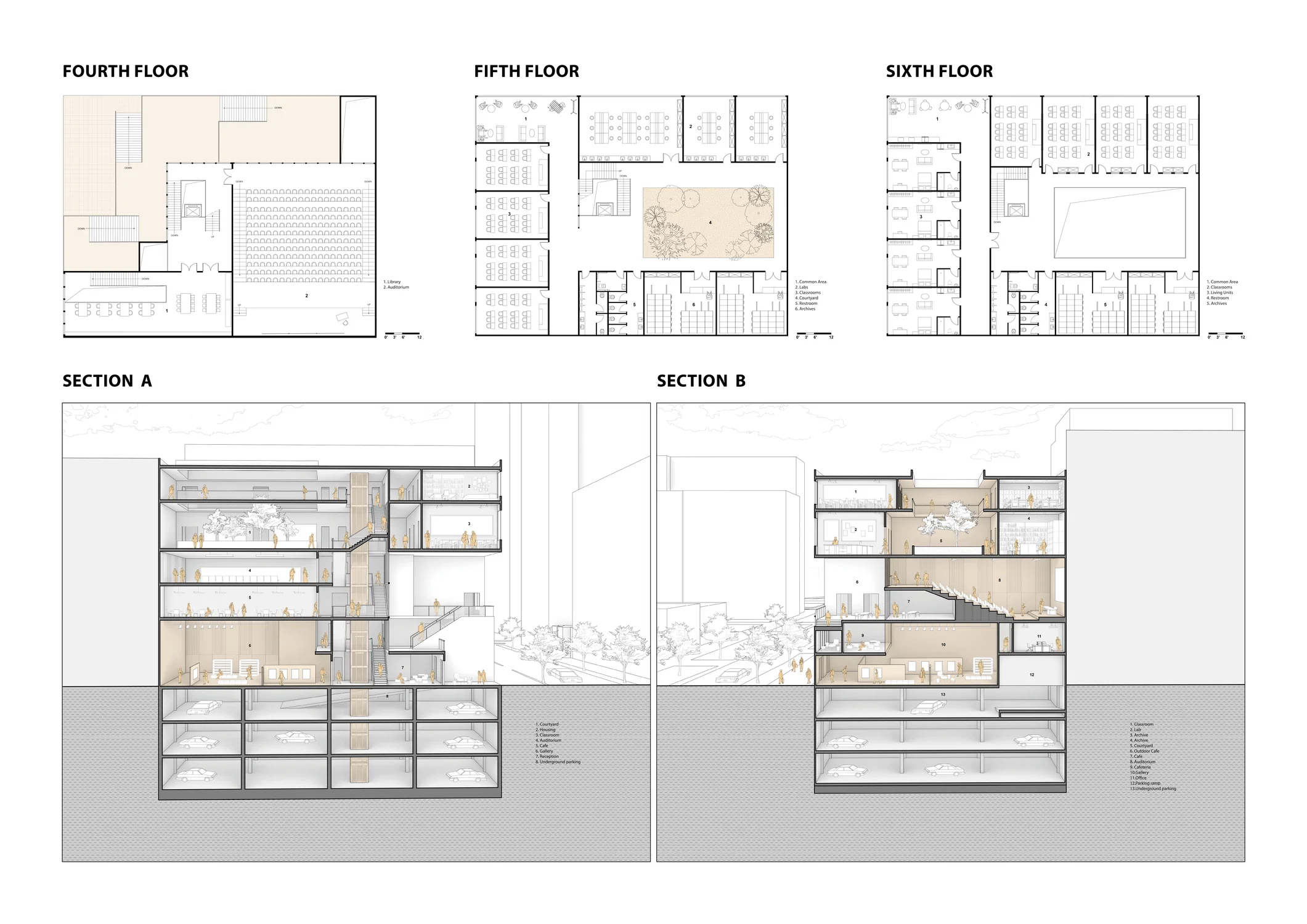
Vic Hsu
sections and floor plans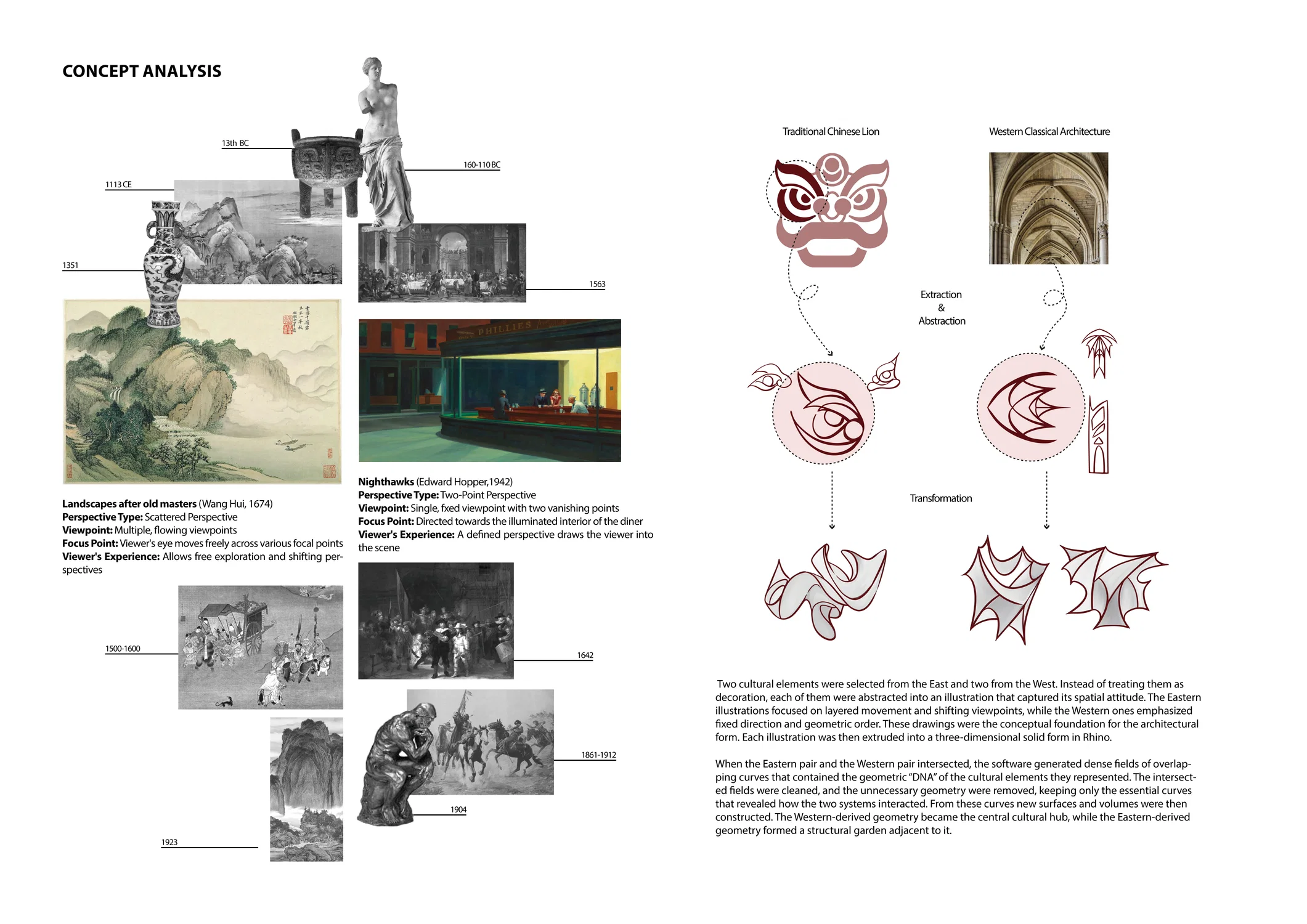
Vic Hsu
Two cultural elements were selected from the East and two from the West. Instead of treating them as decoration, each of them was abstracted into an illustration that captured its spatial attitude. The Eastern illustrations focused on layered movement and shifting viewpoints, while the Western ones emphasized fixed direction and geometric order. These drawings were the conceptual foundation for the architectural form. Each illustration was then extruded into a three-dimensional solid form in Rhino.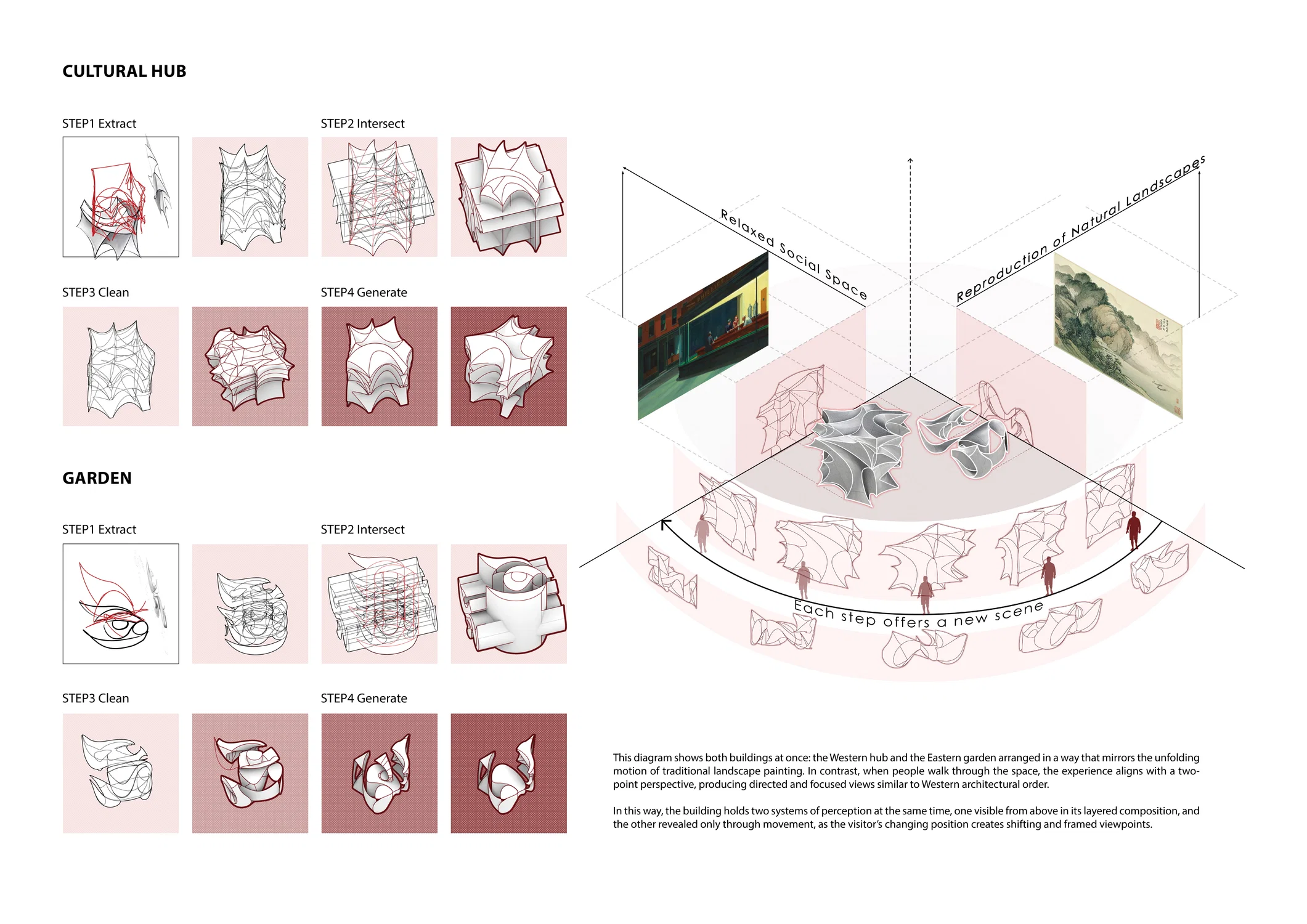
Vic Hsu
When the Eastern pair and the Western pair intersected, the software generated dense fields of overlapping curves that contained the geometric “DNA” of the cultural elements they represented. The intersected fields were cleaned, and the unnecessary geometry were removed, keeping only the essential curves that revealed how the two systems interacted. From these curves new surfaces and volumes were then constructed. The Western-derived geometry became the central cultural hub, while the Eastern-derived geometry formed a structural garden adjacent to it.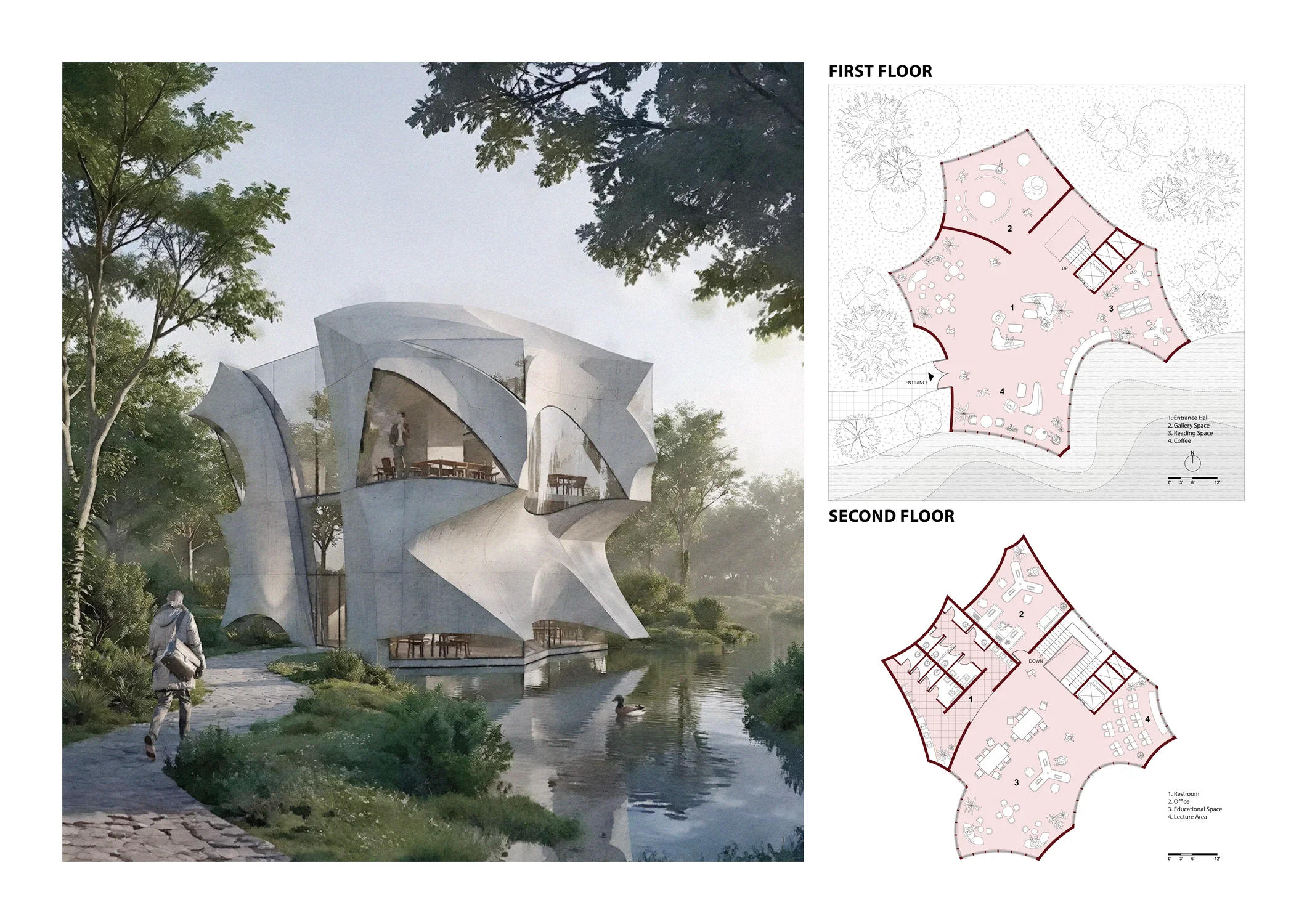
Vic Hsu
Render view and floor plans
Vic Hsu
BFA Environmental Design
I am from Taipei, Taiwan. My work explores how architecture operates across scales,
from material and spatial experience to broader systems of circulation and community
resilience. I am particularly interested in how design can shape meaningful, adaptable
environments. I bring a strong foundation in design, collaboration, and sustainable
thinking, and I look forward to applying these approaches in my future work.
Email Vic Hsu